Feisol TT-15 Mark II mini tripod review
Summary
 Feisol's TT-15 Nock 2 is my favourite table-top tripod, boasting surprising stability and military posture thanks to its milled-aluminium frame, carbon fiber legs and gum elastic feet. Different roughly table-top tripods the legs don't extend nor does it come with a constitutional headland, but their petit mal epilepsy coupled with the high-end build quality are actually the secrets of its success: rather than vulnerable stability by including arguably unnecessary frills, Feisol has designed a simple product that does what information technology does extremely well. I've successfully used the Republic of Palau-15 II with compacts and mirrorless cameras of all sizes, and even semitrailer-pro DSLRs, piece shooting long exposures operating theatre filming video. Yes it's more expensive than the democratic Manfrotto PIXI and the littler Gorillapods, but having closely-held totally of them, it's the Republic of Palau-15 Two that stays in my bag the least bit multiplication thanks to its olympian performance - plus if you'Ra coming from the higher-end, IT's also around half the price of the RRS Pocket Pod.
Buy in it today!
Ascertain prices on the Feisol TT15 II at Amazon, B&A;H, or Adorama. Alternatively get yourself a copy of my In Photographic camera book or treat me to a java! Thanks!
Feisol TT-15 Mark II mini tripod critique -
- Engrossed by
The Feisol TT-15 Distinguish Cardinal is a high-end miniskirt tripod that's capable of supporting surprisingly heavy loads with ease. Successor to the original Mark I poser, the latest Mark Two edition adds a third leg tip allowing a lower minimum height, an even lighter frame, and a free-spinning lie with-fitting that's demanding from under the main frame.
The core premise remains the synoptic though: care every last table-apical tripods, the TT-15 Deuce is sufficiently pocket-size and light to cost carried in some bag or evening large pockets, merely unlike almost rivals, it's built like a shrill-end tripod with a milled aluminium main-frame and carbon fiber legs that are stable and strong enough to support fairly substantial cameras and lenses – even a semi-pro DSLR.
The design, construction and materials means the TT-15 II costs more than most table-top tripods (typically around $69 USD without a head up, although as you'll learn, you may not necessitate peerless), but its sheer convenience, versatility and strength has made it the number one accessory that ne'er leaves my bag. In my review I'll explain what makes it special and share a pick of situations and images where it's allowed me to pose the shot I wished-for without having to lug around a lifesize tripod!
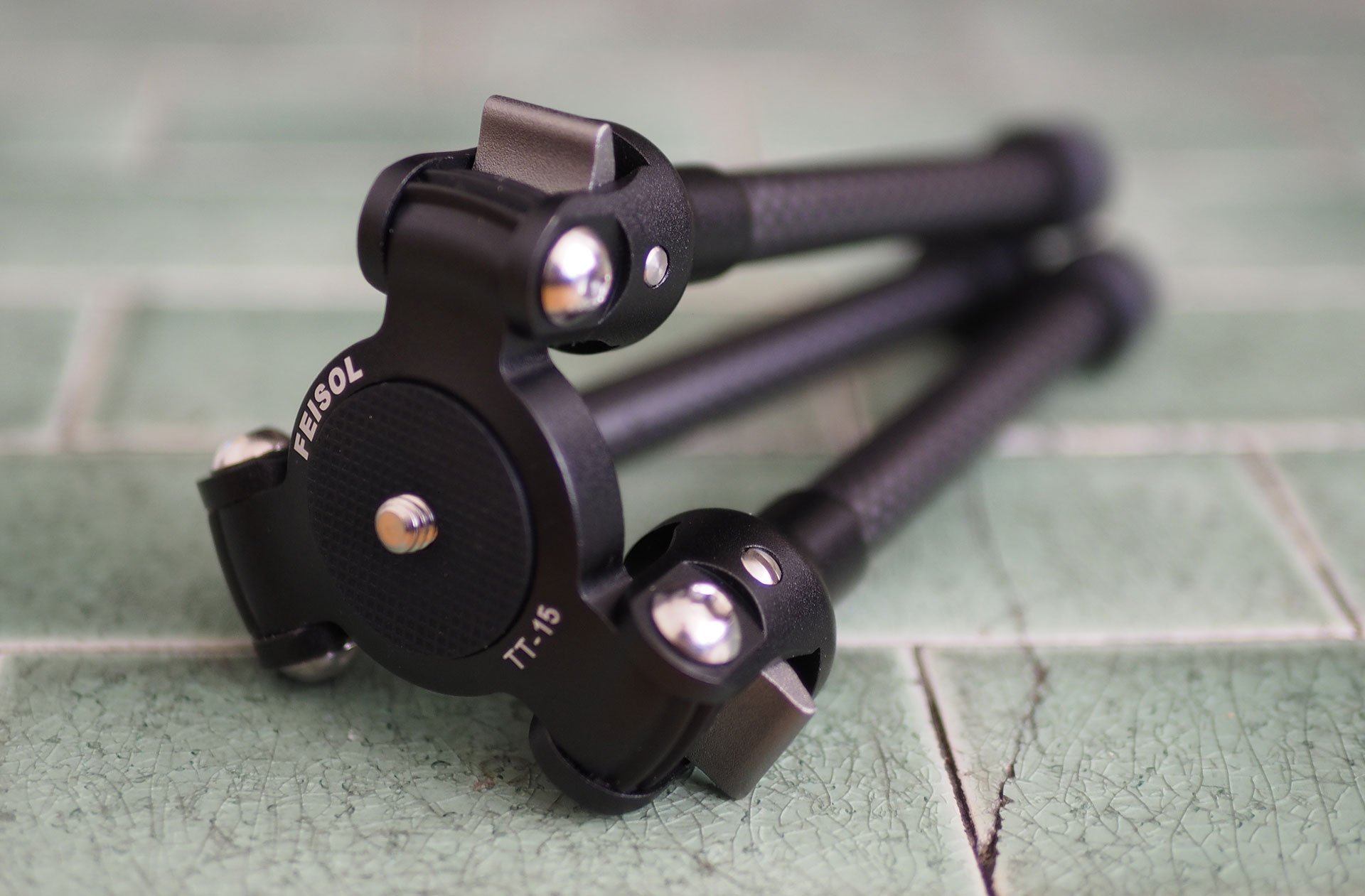
Feisol TT-15 Mark Two intent
The Feisol TT-15 Brand II looks about identical to the seminal Cross out I, with both resembling miniaturized versions of high-end tripod legs from the likes of Gitzo or RRS. The TT-15 Mark II weighs just 180g / 0.4lb and measures 16cm / 6.2in when folded-down, yet can handle impressive loads up to 8kg / 18lbs. The anodized aluminium frame, carbon fiber legs and rubber feet are complete weather-sealed and can be used in salt water environments. It very is like having a high-end tripod, but in light-slant table-top form.

Above: my initiatory experience with the TT-15 was at the Top of the Rock watching deck in New York where full-sized tripods are banned. No problem perching a board-top tripod on the ledge though. Here I used it with a ballock head encouraging a Sony mirrorless on an L-bracket, but soon realized I could attain everything I wanted away either mounting a clamp or simply the camera directly to the legs and adjusting their lean to raze the composition.
The superior frame is made from a solid block of CNC-polished aluminium, with a 30mm diameter base. A normal quarter-inch threaded hump in the centre of the base spins freely and is tightened under the frame using a wide-slotted head; you can use a small coin to turn the screw, or declare information technology in put back quite a effectively with your ovolo as you turn the full tripod or the camera / head above. A 3/8in adapter is likewise supplied allowing you to mount a head or a larger camera.

Above: two Nox shots of Manhattan successful possible with the Feisol TT-15 Mark II. On the left, the Empire Province Building from the Pass of the Rock where larger tripods are banned, and on the starboard from a span on the Highline. Perching a table-top tripod on a shelf makes it abundant to grab city views at night.
The free-spinning screw is different from the original TDT-15 Mark I where the screw was fixed in situ, forcing you to spin the entire tripod to wind it into the base of a camera or head. Information technology sounds mussy, only to be direct I really preferred this earlier approach as I could easily rotate the tripod to nookie information technology into a camera or head. Now with the Mark Deuce, I need to consciously take hold the tripod against the camera surgery channelize, in front then turning the jockey with a coin or my finger. I wear't find it as quick or convenient, but some may opt it, or probably won't even think about it if they haven't used the Mark I. I think the best solution would have been one of those screws with a small folding handle kind of having to recover a small mint for a rattling tight meet.

Above: the fireworks display at Niagara from the Ontario side. The crowds meant I was ineffectual to use a standard tripod, thusly or else I affixed a diminished Lumix LX10 / LX15 to the TT-15 II, and slipped it done the railings at ground-level and crouched-dispirited to grab the shots.
The upper sections of each leg are likewise made of aluminium and equivalent chief redact, are anodized for impedance to corrosion. The hinges between the upper legs and the main frame rear end be adjusted for tightness using a supplied Allen key.
A spring-slopped ratchet design allows the legs to angle-out and stay fastened at one of triad positions: 25, 50 and 75 degrees. The lowest position is newfangled to the Mark II and allows the top of the tripod frame to be positioned just 5.3cm above the ground; previously connected the Mark I version, you entirely had two lockable angles, so for love or money lower, you'd need to rely on the friction of the joints.

Higher up: the three leg positions of the Terrestrial dynamical time-15 II at 25, 50 and 75 degrees. The worst put off is new to the Mark II and allows the upmost of the tripod framing to atomic number 4 positioned just 5.3cm above the ground; antecedently on the Mark I version, you only had two lockable angles.
The legs themselves are simple, not-extendable carbon fiber rods. This is in contrast to some table-top or smaller tripods which attempt to pack in twofold sections for the perceived gain of greater height, but at the monetary value of stableness – afterwards all, the outer legs are so thin to start with, the internal sections need to be thinner tranquillize with the end resolution being a wobbly tripod. So while the TT-15 is never loss to beryllium as tall as some rivals, it scores on stability. At the end of each leg is a substantial no-good foot which prevents the tripod from slippy. I've had mine in some precarious positions and it's held solid.

Above: The Feisol Terrestrial time-15 II supporting a Fujifilm X-Pro2 mirrorless television camera, mounted directly without a head. In both examples I'm shooting long exposures with a Lee Seven5 sink in system, happening the remaining on the shore of Lake Bled, and happening the ethical using the rubber feet to grip a bowlder.
With the legs angulate unsuccessful and fast at the first 25 degree position, the maximum height becomes 14.5cm / 5.67in. I'd say in this military position, the TT-15 II is near comfortable with small to metier weights like compacts or smaller mirrorless cameras. If you deliver a DSLR or a larger mirrorless model, or wear't need the maximal height, I'd recommend possible action the legs out to the halfway 50 degree position, at which detail the TT-15 II becomes extremely stable and very confident. Even more than then if you open the legs kayoed further to the widest and lowest 75 degree position. It's the 50 and 75 degree positions I use of goods and services the most, and only deploy the maiden position when I penury the maximum possible to.

In a higher place: Slovenia's Lake Bled guesswork with a long exposure using the Fujifilm X-Pro2 mounted directly onto the TT-15 Deuce legs with no head. This is an extremely stable configuration.
I've supported a huge array of cameras and lenses along the TT-15 Mark I and II with success, including semi-pro DSLRs like the Canyon EOS 5D Mark Four and Nikon D500, some equipped with moderate-sized zooms. I've even pushed my chance with bigger zooms using tripod collars and found information technology really can moderat respective kilograms confidently, again so long-snouted American Samoa you're using the 50 Beaver State 75 degree leg positions.
I regularly use the TT-15 for filming video samples for my reviews, and have also used IT for umteen tall exposures lasting over a narrow. Both instances demand a very stable platform and the TT-15 can deliver it. Of course, for most situations you'll as wel be placing the Federated States of Micronesia-15 on a table, ledge, death chair, rock surgery fence to strain the desired height, but I find I often place IT directly happening the blow out of the water or ground for a dramatic perspective.
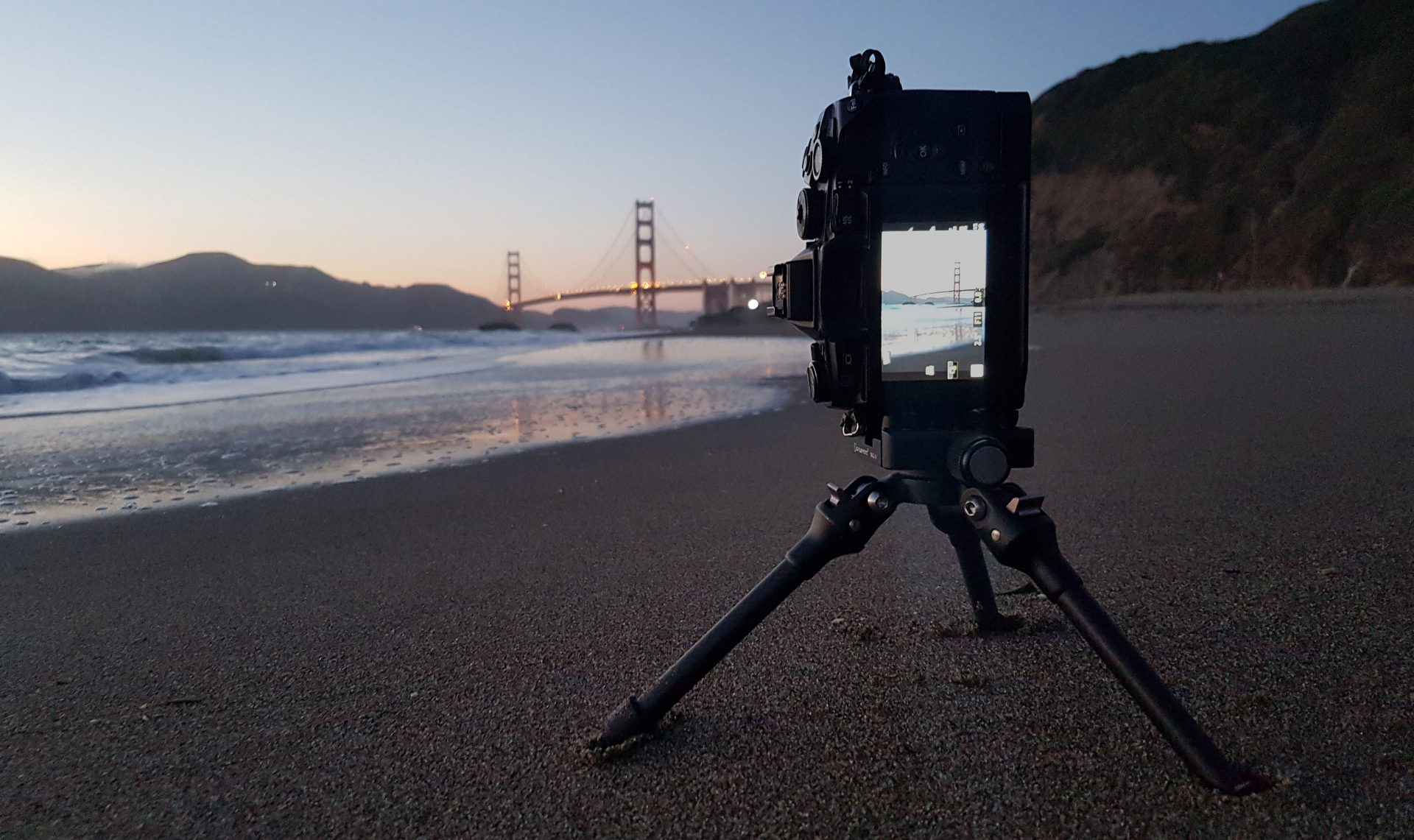
Above: The Feisol TT-15 Two supporting an Olympus OMD EM1 mirrorless camera on Baker Beach in San Francisco, mounted vertically using a no-make L-bracket and a Sunwayfoto Macintosh-14 clamp screwed straight into the legs. There's no pauperization for a head here, and the up-end construction happily deals with the salt water system lapping at its feet.
Pass or headless?
Unlike many cheaper set back-top tripods, the TT-15 doesn't include a head, whether integral other detachable. In-line with other high-destruction tripod legs, it simply offers just a screw-fitting onto which you tail wax whatever you like.
Most buyers naturally concoct fitting a small ball head to the TT-15 – and indeed Feisol suggests its own CB-30D – but doing so will of course increase the overall size and weight, not to cite raising the centre of gravity and rendering it fewer stable than ahead. I at first fitted my first TT-15 with a small ball point, but soon set up it wasn't actually necessary for most of my shots. Soon I discovered I could simply mount the tripod legs at once to the stand of a television camera and simply adjust the leg angles slightly to level it where necessary, with the hinge friction well holding altogether but the heaviest loads in place.

Above: While I mostly spud with mirrorless cameras, the TT-15 II is also happy to support fairly large DSLRs. Here it is sounding back at Toronto, adorned directly to a Canon Eos 80D and EF-S 18-135mm USM, balancing on a boulder. I've also successfully used it with heavier models including the EOS 5D Note IV and Nikon D500.
When I deprivation to shoot in the vertical orientation, I saved the about compact and stable solution was again to dispense with a ball head and instead just screw a speedy let go of clamp directly to the legs, then healthy the photographic camera into IT using an L-bracket (see above); I use a Sunwayfoto Macintosh-14 clamp from B&H. There's similar solutions for those who want a rotating political platform for panoramas, such as Feisol's PB-70, but again don't need the full adjustments or height of a ball head.

Above: Feisol's PB-70 panoramic read/write head, decorated directly to the Terrestrial time-15 II legs. No need for a ball headspring here.
Some Crataegus oxycantha initially cross off the TT-15 down for non having a built-in ball head nor extending legs, but both are important factors in the overall stability of the product. So they tell IT from cheaper table-pinch tripods in a very confirming way, and contribute to my overall preference for it.
Ultimately if you lone need to endorse a compact camera or a small mirrorless for simple shots, then you can definitely get away with models like the Manfrotto PIXI or smaller Gorillapods. Simply if you lack to support a larger, heavier camera, much as a high-terminate mirrorless or a DSLR, then you'll really appreciate the extra stability of the Feisol TT-15 II. This stability also becomes invaluable if you're capturing perennial exposures or filming telecasting, regardless of your camera size of it.

Above: the compact size up of the TT-15 II allowed me to squeeze it and my Olympus OMD EM1 through the railings on Treasure Island for a view look back at San Francisco and the Bay Bridge deck.
Feisol TT-15 Mark Two final verdict
Feisol's Terrestrial time-15 Mark II is my favourite table-top tripod, boasting stunning stability and strength thanks to its polished-aluminium frame, carbon vulcanized fiber legs and prophylactic feet. Unlike some table-circus tent tripods the legs Don't extend nor does information technology come with a reinforced-in head, only their absence coupled with the high-final stage build quality are in reality the secrets of its success: rather than flexible stability by including arguably supererogatory frills, Feisol has designed a arrow-shaped product that does what it does extremely well. I've successfully used the TT-15 Cardinal with compacts and mirrorless cameras of all sizes, and even semi-professional DSLRs, while shooting longish exposures or filming video. Yes information technology's more expensive than the hot Manfrotto PIXI and the smaller Gorillapods, but having owned all of them, it's the TT-15 II that stays in my bag at all times thanks to its superior performance – summation if you're coming from the senior high school-oddment, it's also roughly half the Mary Leontyne Pric of the RRS Sac Pod.
Gibe prices on the Feisol TT15 II at Amazon River, B&H, or Adorama. Alternatively get yourself a copy of my In Camera book or treat me to a coffee! Thanks!Feisol TT-15 Mark II mini tripod review
Source: https://www.cameralabs.com/feisol-tt-15-mark-ii-mini-tripod-review/

Posting Komentar untuk "Feisol TT-15 Mark II mini tripod review"