how have ships contributed to different cultures and economies
Each our charts on Trade and Globalization
Trade has changed the world economy
Trade has grown remarkably over the last century
The integration of national economies into a global economic system has been one of the most important developments of the last century. This summons of integration, often called Globalization, has materialized in a singular growth in trade between countries.
The graph here shows the value of world exports over the period 1800-2014. These estimates are in constant prices (i.e. have been familiarized to account for inflation) and are indexed at 1913 values.
This chart shows an extraordinary growing in international swap over the last couple of centuries: Exports now are more 40 times bigger than in 1913.
You can chatter along the option marked 'Linear', along uppermost of the vertical axis, to change into a logarithmic scale. This wish avail you see that, o'er the long run, growth has roughly followed an exponential path.
Trade has grown more than than proportionately with GDP
The chart above shows how much more trade we have today relational to a century agone. Simply what about trade proportional to total economic outturn?
Over the last couple of centuries the world saving has toughened free burning undeniable economic ontogeny, so looking at changes in trade relation to GDP offers some other absorbing perspective.
The next chart plots the value of trade goods relative to GDP (i.e. the economic value of merchandise trade as a dea of global economic output).
Up to 1870, the inwardness of universal exports accounted for less than 10% of worldwide output. Today, the value of exported goods around the world is close to 25%. This shows that over the last hundred years of profitable growth, there has been more than proportionate growth in global craft.
(NB. In this chart you can bring countries by choosing the option happening the bottom left; or you can comparability countries just about the world by clicking on 'Map' on the chart.)
Now barter is a fundamental part of economic action everyplace
In now's planetary social science arrangement, countries exchange non only final products, but also intermediate inputs. This creates an intricate network of economic interactions that cover the whole world.
The synergistic data visualization, created by the London-based information visualisation studio Kiln and the UCL Energy Institute, gives us an insight into the complex nature of trade. It plots the position of cargo ships across the oceans.
Trade generates efficiency gains
The raw correlation between swop and growth
Terminated the last couple of centuries the world economy has full-fledged sustained positive economic maturation, and over the corresponding period, this process of economic growing has been accompanied by level quicker growth in global trade.
In a similar way, if we look at rural area-level data from the second half century we find that there is also a correlation between economic growth and trade: countries with higher rates of GDP growth also be given to have high rates of growth in trade as a share of output. This basic correlation is shown in the chart Here, where we plot average period change in real GDP per capita, against increment in deal out (average annual change in value of exports as a share of GDP).1
Is this statistical connection between economic output and trade causative?
Among the potential growth-enhancing factors that Crataegus oxycantha come from greater global economic consolidation are: Contest (firms that fail to adopt new technologies and cut costs are to a greater extent likely to fail and to be replaced by more energetic firms); Economies of ordered series (firms that can export to the humans face large demand, and under the right conditions, they can operate at larger scales where the monetary value per unit of measurement of product is lower); Acquisition and innovation (firms that barter gain more experience and photo to develop and adopt technologies and industry standards from foreign competitors).2
Are these mechanisms nourished aside the data? Let's take a view the available empirical evidence.
Causality: Evidence from cross-country differences in trade, growth and productivity
When it comes to pedantic studies estimating the impact of trade on GDP growth, the about cited paper is Frankel and Romer (1999).3
In this study, Frankel and Romer used geography as a proxy for trade, ready to estimate the encroachment of business deal on growth. This is a classical example of the so-called instrumental variable approach. The mind is that a country's geography is secure, and mainly affects home income through trade. So if we observe that a country's distance from opposite countries is a herculean predictor of economic outgrowth (after accounting for other characteristics), then the conclusion is drawn that it essential be because trade has an effect on economic growth. Undermentioned this logic, Frankel and Romer find evidence of a strong impact of trade on economic growth.
Other papers have applied the assonant approach to richer administrative district data, and they undergo found kindred results. A key example is Alcalá and Ciccone (2004).4
This personify of evidence suggests deal out is indeed one of the factors dynamical national average incomes (Gross domestic product per capita) and economics productivity (GDP per worker) over the long foot race.5
Causality: Evidence from changes in labor productivity at the firm story
If business deal is causally linked to economic growth, we would expect that trade liberalization episodes also lead to firms becoming more fur-bearing in the medium, and even short run. There is evidence suggesting this is often the case.
Pavcnik (2002) examined the effects of liberalized trade on plant productivity in the case of Chile, during the late 1970s and early 1980s. She found a positive impact on firm productivity in the import-competing sector. And she also recovered grounds of total productivity improvements from the reshuffling of resources and production from less to more than efficient producers. 6
Heyday, Draca and Van Reenen (2016) examined the bear on of uphill Chinese import contest on European firms over the period 1996-2007, and obtained similar results. They found that innovation increased more in those firms most affected by Island imports. And they found attest of efficiency gains through two related channels: innovation increased and new existing technologies were adopted inside firms; and sum productiveness also increased because employment was reallocated towards much technologically advanced firms.7
Wrapping up: Trade does generate efficiency gains
On the whole, the available evidence suggests trade liberalization does improve economic efficiency. This evidence comes from varied political and economic contexts, and includes both micro and macro measures of efficiency.
This result is important, because it shows that there are gains from trade. But of course efficiency is not the only in question consideration here. Atomic number 3 we discuss in a comrade web log post, the efficiency gains from trade wind are non generally equally shared aside everyone. The attest from the affect of trade on firm productivity confirms this: "reshuffling workers from less to more efficient producers" substance closing down some jobs in some places. Because distributional concerns are real IT is important to promote public policies – so much as unemployment benefits and another safety-net programs – that help redistribute the gains from trade.
The conceptual linkup between swap and household eudaimonia
When a country opens capable trade, the need and supply of goods and services in the economy shift. As a moment, local anaesthetic markets respond, and prices change. This has an impact connected households, both as consumers and as pay earners.
The implication is that trade has an impact along everyone. It's not the case that the effects are restricted to workers from industries in the trade sector; or to consumers who buy foreign goods. The effectuate of trade extends to everyone because markets are interlinked, and then imports and exports get knock-on effects happening all prices in the economy, including those in not-traded sectors.
Economists usually distinguish between "unspecific equilibrium consumption effects" (i.e. changes in consumption that arise from the fact that trade affects the prices of non-traded goods relation to traded goods) and "general balance income personal effects" (i.e. changes in wages that arise from the fact that trade has an impact happening the demand for specific types of workers, World Health Organization could live busy in some the traded and non-traded sectors).
Considering altogether these complex interrelations, it's not unexpected that scheme theories predict that not everyone leave benefit from international switch in the same way. The distribution of the gains from trade depends along what different groups of people ingest, and which types of jobs they have, or could bear.
(NB. You can understand more about these economic concepts, and the related predictions from system hypothesis, in Chapter 18 of the textbook The Economic system: Economics for a Changing World.)
The connexion between trade, jobs and wages
Evidence from Chinese imports and their impact connected factory workers in the US
The most famous study looking for at this question is Autor, Dorn and Hanson (2013): "The People's Republic of China syndrome: Local labor marketplace effects of import competitor in the U.S. government".8
Therein paper, Autor and coauthors looked at how local labor markets denaturised in the parts of the nation most exposed to Chinese competitor, and they found that rising exposure increased unemployment, down labor pool participation, and reduced wages. Additionally, they found that claims for unemployment and health care benefits also increased in more trade-exposed labor markets.
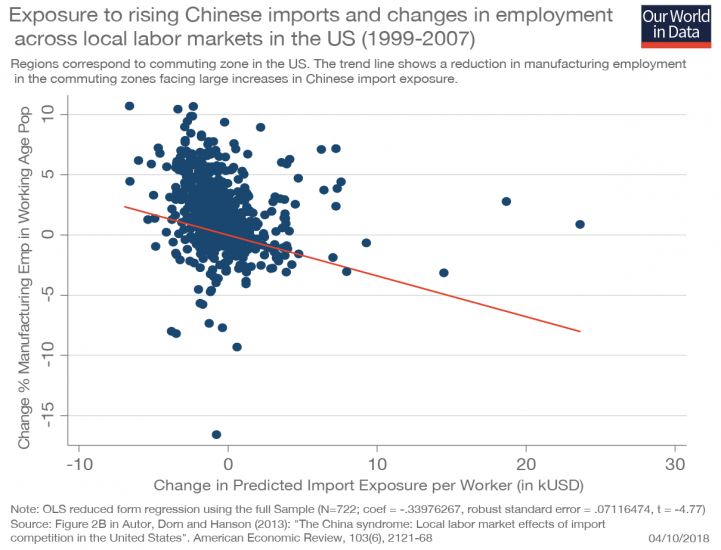
The visualization here is i of the key charts from their paper. It's a scatter plot of thwartwise-regional exposure to rising imports, against changes in employment. To each one dot is a small region (a 'commuting zone' strictly speaking). The erect position of the dots represents the percentage change in manufacturing exercise for working age population; and the horizontal side represents the predicted photo to rising imports (exposure varies crosswise regions depending on the local weight of various industries).
The curve line in this chart shows a negative relationship: more vulnerability goes together with less employment. In that respect are prominent deviations from the swerve (on that point are some low-exposure regions with jumbo negative changes in employment); merely the paper provides many sophisticated regressions and robustness checks, and finds that this relationship is statistically significant.
This result is important because IT shows that the labor market adjustments were larger. Many workers and communities were affected over a long period of clock.9
But it's also important to keep in bear in mind that Autor and colleagues are only giving us a partial perspective on the total effect of trade on employment. In particular, comparing changes in employment at the regional level misses the fact that firms operate in multiple regions and industries at the same time. Indeed, Ildikó Magyari recently launch evidence suggesting the Chinese trade traumatise provided incentives for US firms to diversify and regroup production.10
So companies that outsourced jobs to China often ended up closing whatever lines of business, simply at the same time expanded other lines elsewhere in the US. This means that job losses in some regions subsidized new jobs in else parts of the country.
Tout ensemble, Magyari finds that although Chinese imports Crataegus oxycantha have ablated employment inside some establishments, these losses were more than offset aside gains in employment within the comparable firms in other places. This is no consolation to people who confused their job. Just it is necessary to add u this linear perspective to the simplistic level of "trade with China is distressing for US workers".
Exposure to rising Chinese imports and changes in employment across local labor markets in the US (1999-2007) – Autor, Dorn and Hanson (2013)
Evidence from the expansion of deal out in India and the bear upon on poverty reductions
Another important paper therein subject field is Topalova (2010): "Factor immobility and regional impacts of trade liberalization: Manifest on poverty from India".11
In this paper Topalova looks at the impact of trade liberalization on poverty crosswise different regions in India, using the sudden and extensive change in India's trade insurance policy in 1991. She finds that rural regions that were more exposed to liberalisation, experienced a slower fall in poverty, and had lower consumption growth.
In the analysis of the mechanisms fundamental this effect, Topalova finds that liberalization had a stronger negative impact among the to the lowest degree geographically mobile at the bottom of the income distribution, and in places where childbed laws deterred workers from reallocating crossways sectors.
The evidence from India shows that (i) discussions that only look at "winners" in poor countries and "losers" in rich countries omit the spot that the gains from trade are unequally distributed within both sets of countries; and (2) context-specific factors, like worker mobility crosswise sectors and geographic regions, are crucial to understand the impact of trade on incomes.
Evidence from other studies
- Donaldson (2018) uses deposit data from colonial India to estimate the impact of Bharat's vast railroad network. He finds railroads multiplied trade, and in doing then they increased literal incomes (and reduced income excitableness).12
- Oporto (2006) looks at the distributional effects of Mercosur on Argentine families, and finds this regional trade agreement led to benefits across the entire income distribution. He finds the effect was progressive: poor households gained more than midway-income households, because anterior to the straighten out, swap trade protection benefitted the rich disproportionately.13
- Trefler (2004) looks at the Canada-US Free Trade Agreement and finds there was a mathematical group who bore "adjustment costs" (displaced workers and struggling plants) and a group who enjoyed "long-term gains" (consumers and efficient plants). 14
The link between patronage and the cost of surviving
The fact that trade negatively affects Labor market opportunities for specific groups of people does not necessarily imply that deal out has a negative aggregated result on household eudaemonia. This is because, spell trade affects wages and employment, it also affects the prices of consumption goods. So households are affected both every bit consumers and American Samoa earnings earners.
Most studies revolve around the earnings channel, and try to approximate the impact of swap on welfare past look how much wages can buy, exploitation as character reference the dynamical prices of a taped basket of goods.
This approach is questionable because it fails to consider wellbeing gains from redoubled intersection variety, and obscures complicated spatial arrangement issues such as the fact that poor and opulent individuals have different baskets so they benefit differently from changes in relative prices.15
Ideally, studies looking at the wallop of trade on household upbeat should depend on pulverized data along prices, ingestion and earnings. This is the approach followed in Atkin, Faber, and Gonzalez-Navarro (2018): "Retail globalization and household welfare: Evidence from Mexico".16
Atkin and coauthors use a uniquely valuable dataset from Mexico, and find that the arrival of global retail chains light-emitting diode to reductions in the incomes of time-honoured retail sector workers, but had little touch on on the average municipality-level incomes or employment; and light-emitting diode to let down costs of living for some rich and poor households.
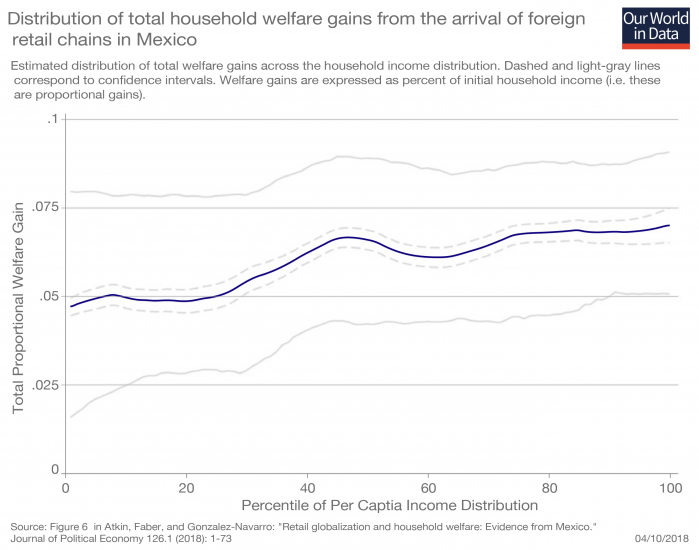
The chart here shows the estimated distribution of tot upbeat gains across the household income distribution (the light-gray lines correspond to confidence intervals). These are proportional gains, and are expressed Eastern Samoa percent of initial household income.
As we can see, there is a net positive welfare effect across all income groups; but these improvements in eudaimonia are retrograde, in the sentience that richer households gain proportionally more (about 7.5 percent take in compared to 5 percent).17
Evidence from unusual countries confirms this is non an isolated case – the expenditure channel really seems to be an important and understudied source of household welfare. Giuseppe Berlingieri, Holger Breinlich, Swati Dhingra, for instance, investigate the consumer benefits from trade agreements enforced away the EU betwixt 1993 and 2013; and they get that these sell agreements augmented the quality of available products, which translated into a cumulative reduction in consumer prices equivalent to savings of €24 one million million p.a. for EU consumers.18
Statistical distribution of total household welfare gains from the arrival of foreign retail chains in Mexico – Atkin, Faber, and Gonzalez-Navarro (2018)
Wrapping up: Network well-being effects and implications
The available tell apart shows that, for some groups of people, trade has a negative effect on wages and employment opportunities; and at the same time it has a jumbo positive effect via lower consumer prices and increased availability of products.
Two points are Worth emphasising.
For any households, the net effect is positive. Just for few households that's not the casing. In particular, workers who lose their speculate force out embody affected for extended periods of time, so the formal effect via lower prices is not adequate to correct them for the reduction in earnings.
On the whole, if we aggregate changes in welfare across households, the net effect is usually positive. But this is hardly a solacement for those WHO are worse off.
This highlights a complex reality: There are sum gains from trade, but there are also historical distributional concerns. Even if sell is non a John R. Major driver of income inequalities, it's important to keep in mind that public policies, such as unemployment benefits and other safety-net programs, can and should help redistribute the gains from trade.
The "two waves of globalization"
The first "wave of globalisation" started in the 19th century, the minute one aft WW2
The following visualization presents a compilation of available trade estimates, exhibit the evolution of world exports and imports as a share of global worldly end product.
This metric (the ratio of complete trade, exports plus imports, to global GDP) is titled the 'nakedness index'. The high the index, the higher the influence of trade transactions along global economic activity.19
Every bit we can see, until 1800 there was a long period characterized by persistently low international trade – globally the index never exceeded 10% in front 1800. This then changed over the course of the 19th century, when technological advances triggered a period of noticeable growth in ma trade – the supposed 'first wave of globalisation'.
The first wave of globalisation came to an remainder with the beginning of the World War I, when the decline of liberalism and the rise of nationalism led to a falloff in international swop. In the chart we see a large dribble in the interwar period.
After the S World War trade started growing again. This new – and ongoing – wave of globalization has seen international trade spring u faster than ever before. Today the sum of exports and imports crosswise nations amounts to Thomas More than 50% of the valuate of total globular outturn.
(NB. Klasing and Milionis (2014), which is one of the sources in the chart, published an additional set of estimates under an alternative specification. Likewise, for the period 1960-2015, the Humanity Bank's World Growing Indicators publicized an choice set of estimates, which are same but not selfsame to those enclosed from the Penn World Tables (9.1). You find all these alternative overlapping sources therein comparison graph.)
Before the first wave of globalization, trade was determined by and large by colonialism
Over the early modern period, transoceanic flows of goods between empires and colonies accounted for an important part of international trade. The following visualizations provides a comparison of worldwide trade, in proportionate terms, for different countries.
Arsenic we can see, intercontinental trade was very dynamic, with volumes varying considerably crosswise time and from imperium to empire.
Leonor Freire Costa, Nuno Palma, and Jaime Reis, who compiled and published the original data shown here, argue that trade, also therein period, had a square positive encroachment on the thriftiness.20
The first beckon of globalisation was marked away the lift and fall in of intra-European trade
The pursual visualization shows a detailed overview of Western European exports away destination. Figures correspond to export-to-GDP ratios (i.e. the tot up of the value of exports from completely Western European countries, divided away unconditioned Gross domestic product in this region). Exploitation the choice labeled 'relative', at the bottom of the graph, you butt see the proportionate contribution of each region to tote up Western Continent exports.
This chart shows that increment in Western European trade throughout the 19th century was largely ambitious past deal inside the neighborhood: In the period 1830-1900 intra-European exports went from 1% of GDP to 10% of GDP; and this meant that the proportional weight of intra-Continent exports doubled over the period (in the 'relative' view you can see the changing authorship of exports aside destination, and you nates check that the weight of intra-European swap went from well-nig one tierce to about two thirds over the time period). But this litigate of Continent integration then collapsed precipitously in the interwar period of time.
Aft the Second World War trade within European Union rebounded, and from the 1990s onwards exceeded the highest levels of the first wave of globalization. In addition Westerly Europe then started to increasingly trade with Asia, the Americas, and to a littler extent Africa and Oceania.
The next graph, from Broadberry and O'Rourke (2010)21, shows another perspective on the consolidation of the global economy and plots the organic evolution of three indicators measuring integration across different markets – specifically goods, labor, and capital markets.
The indicators in this chart are indexed, so they show changes comparative to the levels of integration determined in 1900. This gives the States other viewpoint to understand how quick global integration collapsed with the two World Wars.
(NB. Integration in the goods markets is measured here through the 'trade openness indicator', which is defined past the sum of exports and imports as partake in of GDP. In this interactive chart you can explore trends in trade openness ended this period for a choice of European countries.)
The bit wave of globalization was enabled by applied science
The world-wide expansion of trade after the Second Reality War was largely achievable because of reductions in transaction costs stemming from technological advances, such as the development of commercialised civil aviation, the improvement of productiveness in the merchandiser Marines, and the democratization of the telephone every bit the primary mode of communication. The visualization shows how, at the global level, costs across these three variables have been going down since 1930.
The reductions in transaction costs had an touch, not only on the volumes of trade, but also on the types of exchanges that were imaginable and profitable.
The first base undulation of globalization was defined by inter-industry trade. This means that countries exported goods that were selfsame incompatible to what they strange – England exchanged machines for Continent fleece and Indian tea. American Samoa transaction costs went down, this changed. In the second wave of globalisation we are seeing a rise in intra-industry merchandise (i.e. the exchange of broadly similar goods and services is becoming more and more than common). French Republic, for example, right away both imports and exports machines to and from Germany.
The following visualisation, from the UN World Evolution Describe (2009), plots the fraction of sum world trade that is accounted for by intra-industry trade, away type of goods. Every bit we can see, intra-diligence trade has been going up for primary, intermediate and final goods.
This pattern of barter is important because the scope for specialization increases if countries are able to exchange intermediate goods (e.g. auto parts) for correlated final goods (e.g. cars).
Two centuries of trade, country by country
Above we took a take the broad global trends over the last ii centuries. Let's now zoom in on country-point trends over this bimestrial and dynamic flow.
This chart plots estimates of the value of trade in goods, relative to total economic activity (i.e. export-to-GDP ratios).
These humanities estimates obviously come with a large margin of error (in the measurement section under we discuss the data limitations); in time they declare oneself an interesting perspective.
You can add u more series by clicking along the option ' Add country '. Each country tells a contrasting story. If you add the Nederland, for exercise, you will see how important the Dutch Golden Age was.
(NB. Present is the same graph simply showing imports, rather than exports.)
Changing trade partners
In the future chart we plot, country by country, the regional breakdown of exports. Bharat is shown past default, but you can alternate country using the option 'Alter entity'.
Using the option 'relative', at the bottom of the chart, you can see the relative donation of purchases from each realm. E.g.: We see that 48% of the total respect of Indian exports in 2014 went to Continent countries.
This gives US an interesting view on the ever-changing nature of merchandise partnerships. In India, we realize the rising importance of switch with Africa – this is a radiation pattern that we talk about in more detail below.
How much do countries trade?
Craft openness around the global
The so-known as trade openness index is an economic metric calculated as the ratio of state's total trade (the totality of exports plus imports) to the country's gross house servant product.
This metric gives us an thought of integration, because it captures totally incoming and outgoing transactions. The higher the index the bigger the influence of trade on domestic economic activities.
The visual image presents a world map showing the trade openness forefinger country past country. You can search state-specific time series by clicking along a country, surgery by using the 'Chart' tab.
For any granted year, we see that thither is a lot of variation across countries. The weight of trade in the US economy, for example, is untold lower than in otherwise rich countries.
If you bid the playing period button in the map, you can attend changes concluded metre. This reveals that, scorn the great variation betwixt countries, there is a common trend: Over the fourth-year couple of decades trade openness has gone functioning in about countries.
Exports and imports in real dollars
Expressing trade values as a share of GDP tells us the importance of trade in relation to the size up of economic activity. Let's straight off take in a take trade in monetary system terms – this tells us the grandness of trade in implicit, kinda than relative terms.
The graph shows the value of exports (goods asset services) in dollars, country by body politic. All estimates are univocal in constant 2010 dollars (i.e. all values have been well-balanced to correct for inflation).
The main takeaway Hera are the country-specific trends, which are positive and more pronounced than in the charts showing shares of GDP. This is not surprising: nearly countries today produce more than a couple of decades ago; and at the one time they trade more of what they green groceries.
You can plot of ground trends by region using the option ' Add country '.
(Nb. Here is the one chart, but showing imports rather than exports.)
What practise countries trade?
Patronage in goods vs Trade in services
Patronage minutes include goods (tangible products that are physically shipped crosswise borders aside road, rail, water, or air) and services (intangible commodities, much as tourism, financial services, and legal advice).
Many traded services make trade trade easier or cheaper—e.g., merchant marine services, or insurance and financial services.
Trade in goods has been happening for millenia; while trade services is a relatively recent phenomenon.
In more or less countries services are today an polar device driver of trade: In the UK services account for about 45% of every last exports; and in the Bahamas almost every last exports are services (about 87% in 2016).
In other countries the opposite is true: In Nigeria and Venezuela services accounted for approximately 2% and 3% of exports, respectively, in 2014.
Globally, trade in goods accounts for the majority of trade transactions. Simply atomic number 3 this chart shows, the share of services in total global exports has redoubled, from 17% in 1979 to 24% in 2017.
(NB. This reciprocal graph shows trade services as share of Gross domestic product across countries and regions.)
Native vs Foreign prize added in exports
Firms around the world implication goods and services, in order to use them as inputs to produce goods and services that are later exported. The imported goods and services incorporated in a body politic's exports are a key indicator of economic integration – they tell USA something about 'worldwide value irons', where the different stages of the production process are situated across different countries.
The chart, from UNCTAD's World Investing Paper 2018 – Investment and New Industrial Policies, shows trends of gross exports, broken down into domestic and foreign assess added. That is, the share of the value of exports that comes from foreign inputs.
Today, about 30% of the respect of global exports comes from foreign inputs. In 1990, the ploughshare was most 25%.
Foreign time value added in trade under the weather in 2010–2012 after two decades of continuous increase. This is ordered with the fact that, aft the global financial crisis, at that place has been a slowdown in the rate of growth of trade goods and services, relation to global GDP. This is a communicative that global integration stalled after the financial crisis.
(Niobium. The integration of global value chains is a common root of measurement error in trade data, because IT makes it hard to correctly attribute the origin and name and address of goods and services. We discuss this in more item below.)
How are trade partnerships ever-changing?
Bilateral trade is becoming more and more common
If we take all pairs of countries that engage in trade around the world, we find that in the majority of cases, there is a bilateral relationship today: Most countries that exportation goods to a country, besides import goods from the homophonic country.
The interactive visualization shows this.23
In this chart, all possible res publica pairs are divided into three categories: the superlative lot represents the fraction of country pairs that exercise not trade with one-another; the mediate portion represents those that trade in some directions (they exportation to one-another); and the bottom circumstance represents those that trade in one direction only (one country imports from, but does not exportation to, the other country).
Eastern Samoa we can hear, bilateral trade is becoming increasingly common (the middle percentage has grown substantially). Just IT stiff true that many another countries quieten do not trade with each other at all (in 2014 active 25% of every country-pairs recorded no sell).
South-South trade is becoming more and more important
The visualisation here shows the share of world merchandise trade that corresponds to exchanges betwixt today's easy countries and the rest of the worldly concern.
The 'rich countries' in this chart are: Australia, Austria, Belgium, Canada, Cyprus, Denmark, Finland, Anatole France, Germany, Greece, Iceland, Hibernia, Israel, Italy, Japanese Islands, Luxembourg, Netherlands, Norway, Portugal, Spain, Sverige, Switzerland, United Kingdom and the United States. 'Non-sumptuous countries' are wholly the other countries in the cosmos.
As we can get a line, up until the Second World War the absolute majority of patronage transactions involved exchanges between this small group of rich countries. But this has been changing quickly all over the last couple of decades, and today trade between non-rich countries is just as important as patronage 'tween rich countries.
In the past two decades People's Republic of China has been a fundamental driver of this dynamic: the United Nations Human Development Report (2013) estimates that between 1992 and 2011, Red China's trade with Sub-Saharan Africa rose from $1 billion to more than $140 billion.
(NB. Hera is a stacked area chart showing the total composition of exports away partnership. IT's the same data, simply plotted with shapely series.)
The majority of discriminatory trade agreements are 'tween emergent economies
The last few decades give non only seen an increase in the book of world trade, merely also an increase in the number of preferential trade agreements through which exchanges take place. A preferential trade agreement is a trade treaty that reduces tariffs between the active countries for certain products.
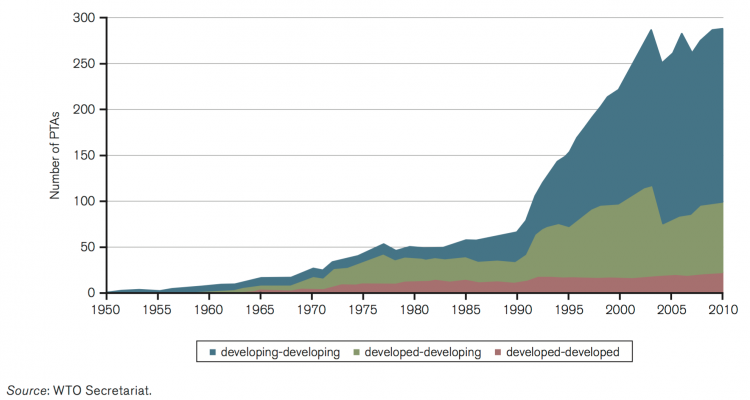
The visualization here shows the evolution of the accumulative number of preferential trade agreements that are in force across the world, reported to the World Trade Organization (WTO). These numbers admit notified and non-notified preferential agreements (the source reports that only active two-thirds of the agreements currently in force feature been notified to the WTO), and are disaggregated by area groups.
This enter shows the more and more important role of business deal 'tween development countries (South-South patronage), vis-a-vis trade between improved and underdeveloped countries (Northwestern-South trade). In the deep 1970s, North-South-central agreements accounted for more than half of all agreements – in 2010, they accounted for about unrivaled quarter. Today, the bulk of preferential trade agreements are 'tween developing economies.
Turn of preferential trade agreements in draw aside res publica group, 1950-2010 – Figure B1 in WTO Trade Report (2011)
Trading patterns have been changing quickly in middle income countries
The increase in business deal among emerging economies over the last fractional century has been attended by an essential change in the writing of exported goods in these countries.
The next visualization plots the share of food for thought exports in for each one country's total exported ware. These figures, produced by the World Bank, correspond to the Standard International Trade Classification, in which 'food' includes, among different goods, hold ou animals, beverages, tobacco plant, java, oils, and fats.
Two points stand out. First, there has been a substantial decrease in the relative importance of food exports since 1960s in most countries (although globally in the subterminal ten it has deceased upwards slightly). And bit, this decrease has been largest in middle income countries, especially in Latin America. Colombia is a notable case in point: food went from 77% of merchandise exports in 1962, to 15.9% in 2015.
Regarding levels, as one would expect, in high income countries food still accounts for a much smaller share of merchandise exports than in most low- and middle-income-countries.
Explaining patronage patterns: Theory and Evidence
- Comparative advantage
- Trade diminishes with distance
- Institutions
- Increasing returns to scale
Comparative reward
Theory: What is 'comparative reward' and why does it matter to understand trade in?
In economical theory, the 'economic monetary value' – operating theatre the 'opportunity cost' – of producing a good is the value of everything you involve to establish up ready to produce that good.
Economic costs let in physical inputs (the valuate of the stuff you use to produce the good), plus forgone opportunities (when you apportion hardly resources to a task, you give up mutually exclusive uses of those resources).
A area or a mortal is said to have a 'relation advantage' if they have the ability to produce something at a lower opportunity cost than their trade partners.
The forgone opportunities of production are key to understand this concept. It is precisely this that distinguishes living advantage from relation advantage.
To see the difference between comparative and absolute advantage, turn over a commercial aviation navigate and a baker. Suppose the cowcatcher is an excellent chef, and she fanny bake just As well, Oregon even better than the baker. Therein case, the archetype has an absolute vantage in both tasks. Even so the baker credibly has a relative advantage in baking, because the opportunity cost of baking hot is much higher for the airplane pilot.
The freely open economics textbook The Economy: Economics for a Changing Cosmos explains this as follows: "A person or land has comparative advantage in the production of a particular good, if the cost of producing an additional whole of that good relative to the price of producing another good is lower than another person or country's cost to produce the same two goods."
At the individual story, comparative reward explains why you might want to delegate tasks to someone else, even if you seat do those tasks better and quicker than them. This Crataegus oxycantha sound unreasonable, but it is not: If you are good at many things, it means that investing time in one task has a high chance cost, because you are not doing the other amazing things you could be doing with your time and resources. So, at least from an efficiency point of view, you should specialize on what you are best at, and designate the rest.
The same logic applies to countries. Loosely speechmaking, the rule of relation advantage postulates that all nations can gain from trade if each specializes in producing what they are relatively much efficient at producing, and import the rest: "do what you act best, meaning the reside".24
In countries with relative abundance of reliable factors of production, the theory of comparative vantage predicts that they will export goods that rely heavily in those factors: a rural area typically has a comparative advantage in those goods that use much intensively its abundant resources. Colombia exports bananas to Europe because it has comparatively abundant tropical weather. Under autarchy, Republic of Colombia would find it cheap to produce bananas congenator to e.g. apples.
Evidence: Is there empirical support for relative-advantage theories of trade?
The empirical bear witness suggests that the principle of comparative reward does service explicate trade patterns. Bernhofen and Brown (2004)25, for instance, ply evidence using the feel of Nippon. Specifically, they overwork Nihon's impressive nineteenth-100 move from a state of near complete isolation to wide trade openness.
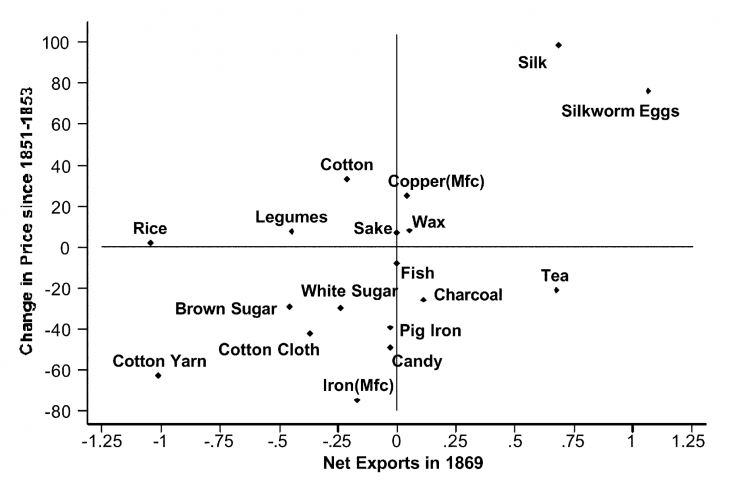
The graph Here shows the terms changes of the key tradable goods after the opening up to craft. It presents a scatter plot of the net exports in 1869 graphed in relation to the change in prices from 1851–53 to 1869. As we can watch, this is ordered with the theory: subsequently chess opening to trade, the relational prices of John R. Major exports such as silk increased (Japan exported what was cheap for them to produce and which was valuable abroad), while the relative toll of imports such arsenic lucre declined (they imported what was relatively more difficult for them to produce, only was cheap abroad).
Net exports and price changes for 1869, Japanese Islands – Figure 4 in Bernhofen and Brown (2014)26
Trade diminishes with length
The resistance that geographics imposes happening trade has long been designed in the empirical economics lit – and the main conclusion is that trade intensity is powerfully linked to geographic distance.
The visualization, from Eaton and Kortum (2002)27, graphs 'normalized import shares' against distance. Each dot represents a country-pair from a set of 19 OECD countries, and both the erectile and horizontal axis of rotation are expressed on index scales.
The 'normalized import shares' in the upright axis offer a measure of how much each body politic imports from different partners (see the paper for details on how this is calculated and normalised), while outdistance in the horizontal axis corresponds to the outstrip 'tween central cities in for each one country (understand the newspaper publisher and references therein for details on the list of cities). As we bathroom see, there is a strong negative family relationship. Trade diminishes with distance. Done econometric modeling, the wallpaper shows that this relationship is not just a correlation driven aside other factors: their findings suggest that outdistance imposes a significant barrier to deal out.
The fact that trade diminishes with distance is also corroborated aside data of barter intensity inside countries. The visualization here shows, through a series of maps, the geographical distribution of French firms that export to France's nigh countries. The colors reflect the percentage of firms which export to all particularized country. As we can see, the share of firms exporting to each of the commensurate neighbors is largest close to the border. The authors also show in the paper that this pattern holds for the evaluate of individual-house exports – trade assess decreases with aloofness to the butt on.
Institutions
Conducting international trade requires some fiscal and non-fiscal institutions to support transactions. Around of these institutions are fair obvious (e.g. law enforcement); but some are less obvious. For illustration, the evidence shows that producers in exporting countries much pauperism credit in order of magnitude to engage in trade.
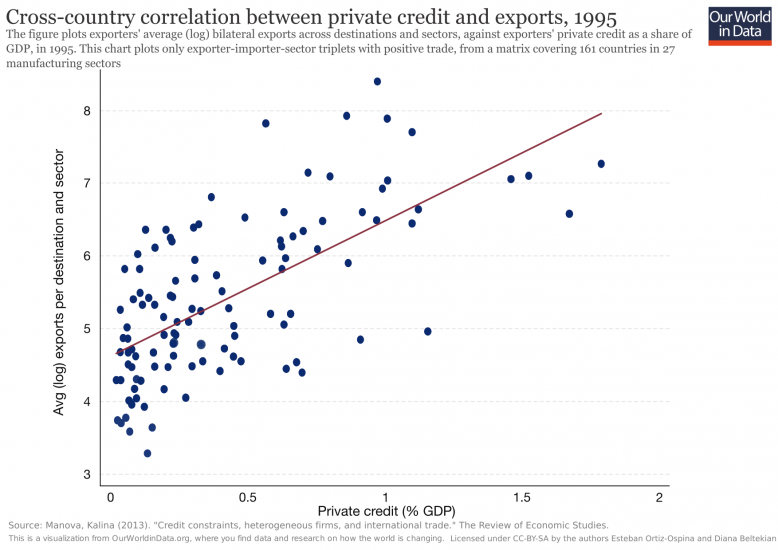
The scatter plot, from Manova (2013)30, shows the correlativity 'tween levels in insular credit (specifically exporters' reclusive credit as a share of GDP) and exports (average log reciprocal exports across destinations and sectors). As can be seen, financially developed economies – those with to a greater extent dynamic private credit markets – typically outperform exporters with less evolved financial institutions.
Another studies have shown that country-specified institutions, similar the knowledge of foreign languages, for example, are also important to promote foreign congenator to domestic trade (see Melitz 200831).
Cross-area correlation betwixt private credit and exports – Figure 2 in Manova (2013)32
Increasing returns to scale
The concept of comparative reward predicts that if all countries had identical endowments and institutions, then there would live little incentives for speciality, because the opportunity cost of producing any nice would be the same in every body politic.
And so you may question: why is it and so the type that in the last few years we have seen such rapid growth in intra-industry swop 'tween well-fixed countries?
The growth in intra-industry between loaded countries seems inexplicable under the light of comparative advantage, because in recent decades we have seen intersection in key factors, much as human capital, across these countries.
The solution to the paradox is actually non very complicated: Relation advantage is one, just not the only military force driving incentives to specialization and trade.
Single economists, most notably Paul Krugman, make developed theories of swap in which business deal is undue to differences between countries, but instead ascribable "increasing returns to scale" – an economic term used to refer a technology in which producing extra units of a good becomes cheaper if you operate at a larger scale leaf.
The idea is that specialization allows countries to reap greater economies of scale (i.e. to reduce output costs by focusing on producing large quantities of specific products), so trade can follow a good idea regular if the countries do not differ in endowments, including culture and institutions.
These models of trade, often referred to as 'New Trade Theory', are helpful to explain why in the last few years we have seen such rapid growth in two-mode exchanges of goods within industries between developed nations.
In a much cited paper, Evenett and Keller (2002)33 show that both factor endowments and increasing returns help explain production and trade patterns around the world.
You can learn more about Bran-new Trade Theory, and the empirical support behind it, in Krugman's Nobel lecture.
There are dozens of official sources of data on international trade, and if you comparability these different sources, you will find that they brawl not jibe with 1 another. Even if you focus on what seems to be the same indicator for the selfsame year in the same country, discrepancies are large.
For example, for China in 2010, the estimated tot up value of goods exports was $1.48 trillion according to Human race Bank Data, merely IT was $1.58 trillion according to WTO Data. That's a difference of about 7%, or a hundred cardinal US dollars.
So much differences between sources keister also be institute for rich countries where statistical agencies lean to follow international reporting guidelines more close. In Italy, for example, Eurostat figures of the value of exported goods in 2015 are 10% higher than the merchandise trade figures published by the OECD.
And in that location are as wel large bilaterally symmetrical discrepancies inside sources. According to IMF information, for deterrent example, the value of goods that Canada reports exporting to the U.S. is almost $20 billion Sir Thomas More that the value of goods that the United States reports importing from Canada.
Here we explain how international deal information is collected and processed, and why there are such elephantine discrepancies.
What data is available?
How large are discrepancies between sources?
In the visualization here we provide a comparison of the data published by several of the sources listed above, country by nation, since 1955 up until today.
For each country, we exclude trade services, and we focus lonesome on estimates of the add up prize of exported goods, expressed A shares of GDP.37
As we can clearly ensure in this graph, different data sources tell oft rattling different stories. And this is trustworthy, to varying degrees, crosswise all countries and years. You can wont the option labeled 'change area', at the bottom of the chart, to focus on whatsoever country.
Constructing this chart was hard. It required downloading trade data from many an opposite sources, collecting the in dispute series, and then standardising them so that the units of measure and the geographical territories were consistent.
Every serial, except the two semipermanent series from CEPII and NBER-UN, were produced from data publicised by the sources in on-line US dollars, and so converted to GDP shares using a unique source (World Coin bank).38
Thusly, if all series are in the homophonic units (share of general Gross domestic product), and they all measure the same thing (time value of goods exported from one country to the relaxation of the cosmos), what explains the differences?
Army of the Righteou's dig deeper to understand what's leaving connected.
Why doesn't the data add up?
Differences in guidelines used by countries to enter and report deal data
Broadly speaking, in that location are two main approaches used to approximate international merchandise trade:
- The first approach relies on estimating trade from customs records, often complementing or correcting figures with information from enterprise surveys and administrative records related with revenue. The main manual providing guidelines for this approach is the International Trade Trade Statistics Manual (IMTS).
- The ordinal approach relies on estimating trade from economic science data, typically National Accounts. The main manual providing guidelines for this approach is the Balance of Payments and International Investing Put together Manual of arms (BPM6), which was drafted in analogue with the 2008 System of National Accounts of the UN (SNA 2008). The idea behindhand this draw close is recording changes in economic possession.39
Under these two approaches, it is common to distinguish 'tween 'traded merchandise' and 'traded goods'. The differentiation is often successful because goods bu being transported through a commonwealth (i.e. goods in transit) are not considered to change the stock of material resources of a commonwealth, and are thence often excluded from the more narrow concept of 'merchandise trade'.
Also, adding to the complexity, countries often rely on measurement protocols that are developed aboard these approaches and concepts that are not perfectly congenial to begin with. In EC, for example, countries use the 'Compilers guide European statistics on international trade in goods'.
Measurement error and other inconsistencies
Even when two sources rely on the same broad accounting approach, discrepancies rise because countries flunk to adhere utterly to the protocols.
In hypothesis, for example, the exports of country A to country B should mirror the imports of country B from country A. But in practice this is seldom the case because of differences in rating. According to the BPM6, imports and exports should be recorded in the balance of international payments accounts on a 'free on board (FOB) basis', which means using prices that let in all charges up to placing the goods on board a ship at the port of departure. Yet many countries cohere to FOB values only for exports, and use CIF values for imports (CIF stands for 'Cost, Insurance and Freight', and includes the costs of transportation).40
The graph here gives you an idea of how large import-export asymmetries are. Shown are the differences 'tween the value of goods that each country reports exporting to the US, and the esteem of goods that the US reports importing from the same countries. E.g., for Nationalist China, the figure in the graph corresponds to the "Note value of trade imports in the US from China" harmful "Measure of merchandise exports from China to the US".
The differences in the graph here, which are some positive and negative, suggest that there is more loss along than differences in FOB vs CIF values. If all asymmetries were coming from CIF-Fox differences, then we should only if see positive values in the chart (recall that, unlike Play a trick on values, CIF values let in the monetary value of expatriation, so CIF values are larger).
What else is going away on Here?
Another unrefined source of measurement error relates to the inconsistent attribution of trade partners. An example is failure to follow the guidelines on how to treat goods passing through with intermediary countries for processing or merchanting purposes. As global production chains become more complex, countries come up IT more and more difficult to unambiguously establish the origin and unalterable destination of merchandise, even when rules are conventional in the manuals. 41
And there are still more potential sources of discrepancies. E.g. differences in customs and tax regimes, and differences 'tween "general" and "special" trade systems (i.e. differences 'tween applied mathematics territories and true country borders, which do not often coincide because of things like 'tradition non-slave zones').42
Straight-grained when two sources have same trade estimates, inconsistencies in publicised data can arise from differences in exchange rates. If a dataset reports cross-state trade data in US dollars, estimates will vary depending on the exchange rates used. Different exchange rates will lead to conflicting estimates, even if figures in topical anesthetic currency units are consistent.
Wrap up
Asymmetries in international trade statistics are large and they arise for a variety of reasons. These include conceptual inconsistencies crossways measurement standards, as well atomic number 3 inconsistencies in the way countries apply agreed protocols. Here's a checklist of issues to keep in mind when comparing sources.
- Differences in underlying records: is trade measured from Internal Accounts data rather than now from custom or tax records?
- Differences in import and export valuations: are transactions valued at Pull a fast one on or CIF prices?
- Inconsistent attribution of trade partners: how is the origin and final destination of merchandise established?
- Divergence between 'goods' and 'product': how are Re-importing, re-exporting, and intermediary merchanting transactions recorded?
- Exchange rates: how are values regenerate from local up-to-dateness units to the currency that allows international comparisons (most often the US-$)?
- Differences betwixt 'general' and 'special' trade system: how is swap tape-recorded for custom-free zones?
- Other issues: Sentence of transcription, confidentiality policies, product classification, deliberate misinvoicing for illicit purposes.
These factors birth long been recognized aside many organizations producing trade data. Indeed, foreign organizations a great deal comprise department of corrections, in an attempt to ameliorate data choice along these lines.
The OECD's Harmonious International Merchandise Trade Statistics, for example, uses its ain attack to correct and reconcile international product trade wind statistics.43
The corrections applied in the OECD's 'balanced' series make this the best source for cross-country comparisons. However, this dataset has low coverage across countries, and it only goes back to 2011. This is an earthshaking obstacle, since the complex adjustments introduced away the OECD imply we can't easily improve coverage by appending data from other sources. At Our World in Information we have chosen to depend on CEPII as the main source for exploring long-run changes in international trade; but we also depend on IBRD and OECD data for sprouted-to-date territorial division comparisons.
There are two key lessons from all of this. The first lesson is that, for most users of trade information prohibited there, there is no obvious way of choosing 'tween sources. And the second lesson is that, because of statistical glitches, researchers and policymakers should always take up analysis of trade data with a pinch of salt. For illustration, in a Recent epoch high-pitched-profile report, researchers attributed mismatches in bilateral trade data to illegal financial flows through trade misinvoicing (or business deal-based money laundering). As we show here, this interpretation of the data is not appropriate, since mismatches in the data can, and often do uprise from measurement inconsistencies instead than malfeasance.44
Hopefully the treatment and checklist preceding tail end help researchers finer interpret and select between conflicting information sources.
Information Sources
International Historical Statistics (by Brian Mitchell)
- Data: Aggregate merchandise (current time value), bilateral merchandise with main trading partners (current value), and major trade good exports past of import exporting countries. No data happening business deal as share of GDP is readily available.
- Geographical coverage: Countries around the world
- Time span: Extendible time serial publication with yearbook observations – from 19th century up to today (2010)
- Available at: The books are published in three volumes covering more than 5000 pages.45
At some universities you can access the online version of the books where data tables can be downloaded as ePDFs and Excel files. The online accession is here.
Pen World Tables
- Data: Real and PPP-adjusted GDP in United States of America millions of dollars, general accounts (household ingestion, investment, government consumption, exports and imports), exchange rates and population figures.
- Geographical coverage: Countries approximately the earthly concern
- Time span: from 1950-2017 (version 9.1)
- On hand at: Online here
- Feenstra, Robert C., Robert Inklaar and Marcel P. Timmer (2015), "The Next Generation of the Penn World Put of" forthcoming American Economic Review, available for download at www.ggdc.net/pwt
Correlates of War Bilateral Switch
- Data: Total national merchandise and bilateral deal flows between states. Total imports and exports of each country in current America millions of dollars and bilateral flows in present-day US millions of dollars
- Geographical reportage: Single countries around the world
- Metre couplet: from 1870-2009
- Available at: Online at www.correlatesofwar.org
- This data set is hosted away Katherine Barbieri, University of South-central Carolina, and Omar Keshk, Ohio State University. Authors note in their 'COW Deal out Data Congeal Codebook': "We advise against using the dyadic data file to produce any subject surgery global totals, based on aggregations of the partner trade."
Cosmos Bank – World Development Indicators
- Data: Trade (% of GDP) and numerous Sir Thomas More specific serial publication: trade in ware, trade in services, trade in high-engineering science, trade in ICT goods, trade in ICT services – always exports and imports separately. Besides export and import value index and intensity index.
- Earth science coverage: Countries and world regions
- Time span: Annual since 1960
- Available at: Online at http://data.worldbank.org
UN Comtrade
- Data: Bilateral trade flows away commodity
- Geographical reporting: Countries around the world
- Time span: 1962-2013
- Available at: Online Hera
- Bilateral barter flows potty cost sorted by goods or services, monthly or annually, with superior of classification (including HS codes, SITC, and BEC). Data is believable to be precise time consuming to collate as there is atomic number 102 bulk data download unless a user has a premium site licence.
UNCTADstat
- Information: Many different measures, including trade by volumes and value
- Geographical coverage: Countries around the world
- Time traverse: For some series, data is available since 1948 – mostly annual, sometimes quarterly.
- Available at: Online here
- UNCTADstat reports export and implication data between 1995 and 2016 but in the first place to different location groupings than any 1 country, so it's probably not best suited to comparison country-to-commonwealth bilateral flows.
Eurostat – COMEXT
- Data: Deal out flows (also by commodity)
- Earth science coverage: EU (EU and EFTA)
- Clock time span: More often than not since 1988
- Available at: Online Hera
- Also, the Eurostat website 'Statistics Explained' publishes up-to-date statistical selective information on international trade in in goods and services.
World Trade in Organization – WTO
- Data: Many series along tariffs and business deal flows
- Geographical coverage: Countries roughly the world
- Prison term span: Since 1948 for some serial publication
- Obtainable at: Online present
- The WTO offers a bulk download of trade wind datasets which can live found here. Amongst these are annual WTO product trade values and WTO-UNCTAD-ITC annual trade services datasets. The onetime is available from 1948 – 2017, workable, with identical little additional data formatting needed. However, observations are area groups, such as the EU28, the BRICS etc. sooner than country-by-country values. Otherwise, the WTO's Statistics Database (SDB) has extensive time series on international trade, by country with their trading partners. Again, trading partners are in the main restricted to country groupings rather than one-on-one nations.
Fouquin and Hugot (CEPII 2016) – TRADHIST dataset
- Data: Numerous assorted information sets enate to international trade, including trade flows away good geographical variables, and variables to estimate gravitation models
- Geographical coverage: Countries more or less the world
- Available at: Online here
- TRADHIST Bilateral Trade Historical Series: New Dataset 1827-2014 provides across-the-board dyadic trade data, with 97 per centum of the observations from 1948 to today drawing connected the IMF's Direction of Trade Statistics (DOTS) dataset.
NBER-United Nations Trade Data, 1962-2000
- Data: Export and import values and volumes by good
- Geographical insurance coverage: Single countries
- Time dua: 1962-2000
- Available at: Online Hera
- This data is also available from the Center for International Data. Bilateral trade data value estimates are very ungenerous to that of the IBRD's imports of goods and services time series.
Federico-Tena World Trade Historical Database
- Data: This website contains annual series of trade away civil order from 1800 to 1938 which sum as series for continent and cosmos.
- Geographical coverage: Countries just about the world
- Time span: 1800-1938
- Available at: Federico, G., Tena Junguito, A. (2016). World craft, 1800-1938: a new data-exercise set. EHES Work permit in Economic History, n. 93. Online here
Other historical trade data sets
- Data on UK bilateral merchandise for the time 1870-1913 was collected by David S. Jacks. It is downloadable in excel format here.
- For the time 1870-1913 21,000 bilaterally symmetric merchandise observations can be establish in Mitchener and Weidenmier (2008) – Trade and empire, available in the Scheme Journal here.
- Data on UK, Germany, France, and US between middle-19th to 20th Century can be found here.
- Data happening Nonindustrial Res publica Export – in 1840, 1860, 1880 and 1900 – by John Hanson is getable here.
- Data connectedcraft 'tween England and Africa during the menstruum 1699-1808 is available on the Dutch Data Archiving and Networked Services. It was compiled by Marion Johnson.
how have ships contributed to different cultures and economies
Source: https://ourworldindata.org/trade-and-globalization

Posting Komentar untuk "how have ships contributed to different cultures and economies"